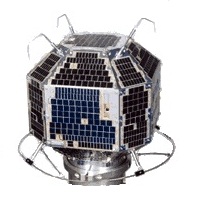
 Fuji-OSCAR 29 – Jas-2 ‘Sixteenth’ birthday.
I so wish JAMSAT and JARL would decide to build another satellite this bird is really great for working linear transponder.
Fuji-OSCAR 29 – Jas-2 ‘Sixteenth’ birthday.
I so wish JAMSAT and JARL would decide to build another satellite this bird is really great for working linear transponder.
 The amateur radio CubeSat HORYU-2 has been successfully sending back images of the Earth.
The team also report the high-voltage power experiment has generated 300 volts. Built by students at the Kyushu Institute of Technology (KIT) HORYU-2 is 350 * 310 * 315 mm and mass is 7.1 kg. It is in a Sun-Synchronous 680 km orbit with an inclination of 98.2°.
The satellite’s callsign is JG6YBW and it transmits on 437.375 MHz (+/- 9 kHz Doppler shift) using 20 wpm Morse Code or 1200 bps AX.25 FSK packet radio. Details of the telemetry format are available here. The telemetry software can be downloaded from here and an explanation of the software is here.
 HORYU-2 Japanese Operating Schedule in Google English http://tinyurl.com/HORYU-2-Schedule
Read the KIT HORYU Blog in Google English http://tinyurl.com/HORYU-Blog
Further information on HORYU-2 … continue reading
Source: Amsat-UK
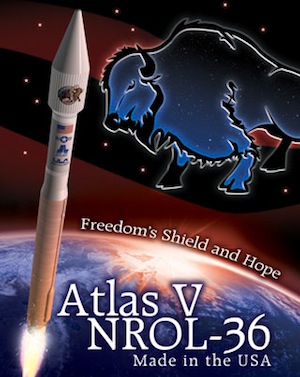 On August 2, 2012 at 07:40 UT an Atlas V rocket is planned to launch a combination of 11 satellites from Vandenberg Air Force Base in California for the US Government and NASA ELaNa university CubeSats.
The primary mission will launch a pair of US Navy Ocean Surveillance Satellites (NOSS). These satellites carry equipment to track ships and aircraft by triangulation of radio transmissions. The two NOSS satellites have a combined weight of 6500 kg. They will separate a few days after being placed into a 1100 km circular orbit at 63° inclination.
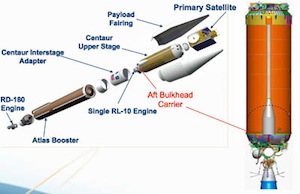 This is the first Atlas V launch with modified helium tanks in the Centaur upper stage. The change has created room in the aft skirt to accommodate 8 P-POD dispensers for CubeSats. This launch carries 11 CubeSats, to be released into 470 x 770 km, 63° orbit about 3 hours after launch and following maneuvers by the Centaur upper stage.
NASA ELaNa Launch and Deployment
3 P-Pods will carry 4 CubeSats as the NASA sponsored “ELaNa VI” cluster:
1. CINEMA (CubeSat for Ion, Neutral, Electron, Magnetic fields)
http://www.eecs.berkeley.edu/Pubs/TechRpts/2010/EECS-2010-83.pdf
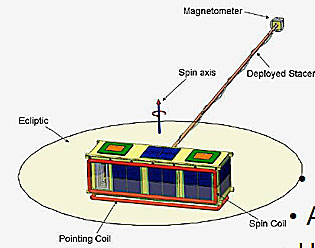 First in a trio of identical nano-satellites studying Space Weather effects in near-Earth space, 3U CubeSat from University of California at Berkeley,
Uplink uses a serial connection with a data rate of 9600 bps.
Downlinks for engineering telemetry and command are in the 2400-2450 MHz range; Science telemetry is in 2200-2300 MHz range.
1 Mbps data rate, Reed-Solomon encoded bit stream.
2. CSSWE (Colorado Student Space Weather Experiment)
http://lasp.colorado.edu/home/about/quick-facts-csswe/
3U CubeSat designed and developed by students at the University of Colorado at Boulder (CU-Boulder). The objective of the science mission is to address fundamental questions pertaining to the relationship between solar flares and energetic particles.
Downlink 437.345 MHz, 9k6 with AX25
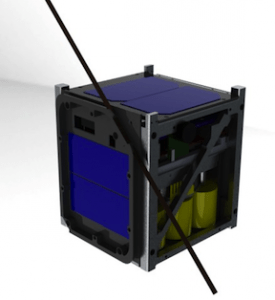 3. CP5 (PolySat)
http://polysat.calpoly.edu/CP5.php
California Polytechnic State University at San Luis Obispo mission with De-Orbiting Experiment Using A Deployed Thin-Film Mechanism.
Downlink 437.405 MHz at 1 watt, AFSK on LSB AX.25 over NRZI at 1200 bps, every 2 minutes, begins 3.5 hours after first turn-on
4. CXBN (Cosmic X-Ray Background Nanosatellite)
http://universe.sonoma.edu/CXBNanosat/
Morehead State University mission to map the entire sky in the X-ray spectrum using high energy cosmic background radiation measurements in the 30-50 keV range. 2U CubeSat.
Downlink 437.525 MHz, GFSK, AX.25
US Government Payloads
5 P-PODs will carry 7 US Government payloads (list subject to confirmation):
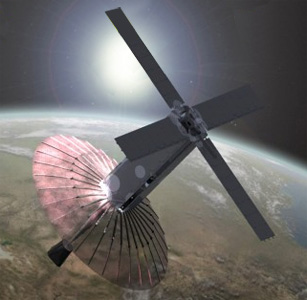 1. Aeneas
Aeneas Project
Department of Homeland Security satellite technology demonstration program to track cargo containers worldwide, 3U CubeSat built by the University of Southern California. Proof of concept mission to prove the concept of WiFi based tag tracking from Low Earth Orbit.
First CubeSat to deploy 2.4 GHz Dish Antenna. WiFi transmitter will transmit on 2425.0 MHz with 1 watt of output power.
Downlink 437.600 MHz AX25 1200 bps beacon every 10 second and a spread spectrum two-way link elsewhere in the 70cm band.
2. ORSES (ORS Enabler Satellite)
Operationally Responsive Space office, 3U CubeSat for the US Army Space and Missile Defense Command.
3. Horus
One of a satellite pair (with Re) has optical sensors to detect orbiting payloads and debris for orbit measurement, 3U CubeSat from Lawrence Livermore National Laboratory.
4. Re
Second satellite of a pair (with Horus) has optical sensors to detect orbiting payloads and debris for orbit measurement, 3U CubeSat from Lawrence Livermore National Laboratory,
5. 6. 7. Aerocube 4A, 4B, 4C
Built and operated by the Aerospace Corporation for technical research.
Data received from RS-40
After I had heard that RS-40 was successfully launched, it was obviously that we where going to try and receive the signals from this new satellite. The first attempt failed because the satellite wasn’t in range of its groundstation. This attempt was made on 28-Juli-2012 in the beginning of the evening.
Today 29-Juli-2012 we tryed again during the pass of 12:30 UTC and recorded some fine signals. I used the data that belongs to Object D. The signal strength varies from 7 to 9 20 db. Switching between RHCP and LHCP can improve the signal strenght with multiple db’s.
Object D
1 38736U 12041D   12211.25399548  .00000010  00000-0  00000+0 0    88
2 38736 082.4798 356.4583 0017226 312.8533 047.1129 12.42642075   135
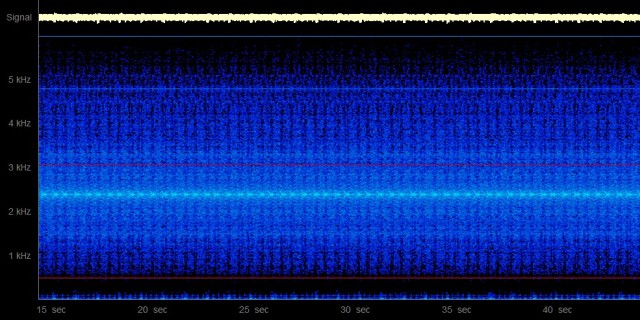
The first signals, switch between the two downlink frequencies, when the signals stop on 435.265.000 MHz FM they start again on 435.365.000 MHz FM. After about six minuts the patern changed and there where only signals on 435.365.000 MHz FM. When you listen close there is a difference between the pattern from the first recording and the second. Something that can’t be seen after the recording, is the fact that the signals of the first pattern have a higher bandwidth, and therefore likely to have a higher baud rate.
First pattern Spectrum:
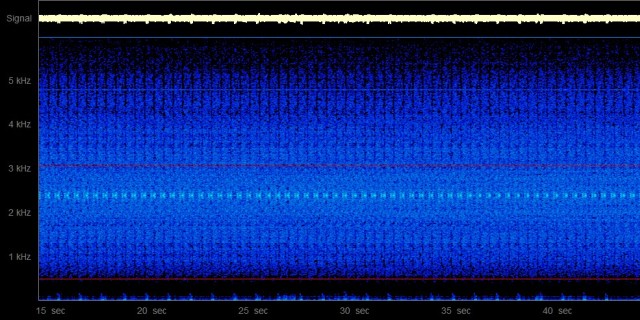
First pattern Audio:
Second pattern Spectrum:
Second pattern Audio:
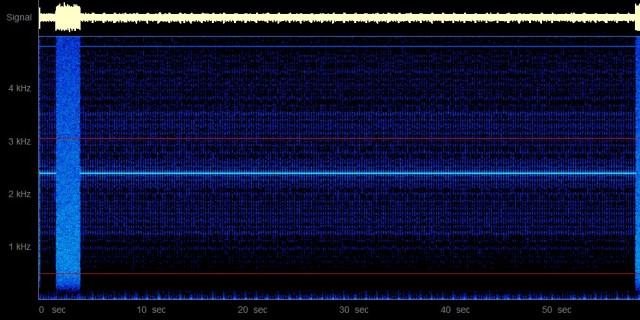
Update: Found a third signal pattern (29-Juli-2012 14:30 UTC)
Third pattern Spectrum:
Third pattern Audio:
Update 10-aug-2012:
Doppler shift measurements show that RS 40 (alias Yubileiny 2, alias MiR) is object 38735 (2012-041C). This is now also confirmed by Space-Track. Thanks PA0DLO for this update in the Amsat-NA mailing list.
YUBELEINY 2
1 38735U 12041C   12222.44615412 +.00000024 +00000-0 +10000-3 0 00171
2 38735 082.4779 349.4791 0016140 289.5665 070.3671 12.42553955001539
If there are people that can give me some extra information regarding this new satellite, please send me an email via the contact page. Information about the team that built the satellite, the ground and decoding software is very welcome.
The first signals are heard from RS-40 (MiR, Yubileiny-2)
Maik Hermenau posted on the Amsat-DL mailinglist that he has received the first Morse-code and Doka-B signals on 435.365 MHz from RS-40. Below the preliminary TLE data
Objekt A
1 38733U 12041A   12210.12685498  .00000010  00000-0  00000+0 0    15
2 38733 082.4857 357.1631 0021734 304.6351 055.4204 12.43547904    04
Zarya website.
| MiR (Yubileiny-2) 2012-041D 38736 | in orbit | ||||||||
| epoch (UTC) | s-m axis ( km ) | ecc | perigee ( km ) | apogee ( km ) | period ( min ) | incl ( ° ) | ω ( ° ) | ||
| 2012 Jul 28, 03:02 | 7870 | 0.0022 | 1474 | 1509 | 115.80 | 82.49 | 305 | ||
[PE0SAT Thanks Maik Hermenau and www.zarya.info for the above information]
Space-Track data 29-July-2012 10:10 UTC
Object A
1 38733U 12041A   12211.19530154  .00000010  00000-0  00000+0 0    77
2 38733 082.4758 356.4905 0017731 319.7709 136.6053 12.42341659   132
Object B
1 38734U 12041B   12211.25373770  .00000024  00000-0  10000-3 0    96
2 38734 082.4774 356.4553 0017923 309.1960 050.7541 12.42928054   144
Object C
1 38735U 12041C   12211.25407631  .00000024  00000-0  10000-3 0    68
2 38735 082.4788 356.4540 0016571 315.0800 044.9038 12.42560236   143
Object D
1 38736U 12041D   12211.25399548  .00000010  00000-0  00000+0 0    88
2 38736 082.4798 356.4583 0017226 312.8533 047.1129 12.42642075   135
Object E
1 38737U 12041E   12210.90747044  .00000009  00000-0  00000+0 0    42
2 38737 082.4805 356.9010 0220691 269.4051 088.1729 12.81773489   126
RS-40 is launched.
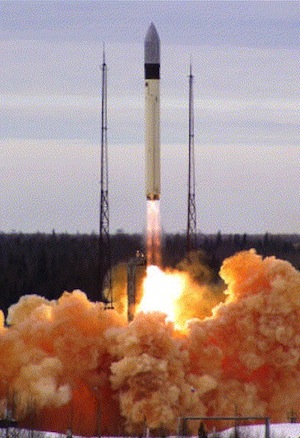 A Russian Rockot Launch Vehicle blasted off from Pad 133/3 at the Plesetsk Cosmodrome at 1:35 GMT on Saturday, July 28 on a mission to deliver four payloads to Low Earth Orbit. All payloads were delivered to their intended orbits and the mission was declared a success by officials. On this flight, three Gonets-M Communication Satellites, the MiR technical demonstration satellite and the Rodnik Satellite for the Ukranian Military Satellite was deployed to Orbit.
This launch marked the Return-To-Flight Mission for the Rockot Launcher that suffered a failure on its previous mission on February 1, 2011 when the Upper Stage of the launcher encountered a malfunction, placing the Payloads in a lower-than-planned Orbit. After the failure, the manufacturer of the Launcher and Upper Stage, the Khrunichev State Research and Production Space Center, suspended Rockot Launches to investigate the cause of the premature shutdown of the Briz-KM Upper Stage. After the cause of the failure was found, Rocket was approved for flight once again. During final preparations for the Return To Flight Launch, a problem with the BrizKM Upper Stage was found and the mission was delayed by three weeks in early July to give teams sufficient time to repair the electronics of the Upper Stage and fix a wiring issue.
Launch occurred on time on July 28 and the Rockot launcher blasted off as expected. Rockot is a two-stage liquid-fueled launch vehicle, usually equipped with a Briz-KM Upper Stage, that is capable of delivering payloads of up to 2,140 Kilograms to Low Earth Orbit and 1,200 Kilograms of Payloads to Sun-Synchronous Orbit. The vehicle stands 29.15 meters tall and has a main diameter of 2.5 meters. Rockot has a launch mass of 107,000 Kilograms and uses Unsymmetrical Dimethylhydrazine and Nitrogen Tetroxide as Propellants. The first stage of the Launcher is 17.2 meters long and is powered by three RD-0233 Engines and one RD-0234 Engine with a total liftoff thrust of 1,870 Kilonewtons. The first stage burns for 122 seconds before being separated. The second stage of the Rockot Launcher is 3.9 meters in length and uses a 240-Kilonewton RD-0235 Engine for propulsion.
*File Image* – Photo: Eurockot – Rockot www.Eurockot.com
The second stage also has four vernier thrusters each providing 16 Kilonewtons of thrust. Second Stage Burn time is 183 seconds. The Briz-M Upper Stage of the vehicle can be ignited multiple times featuring missions with coast phases to reach a variety of orbits. Also, Briz-M provides precise injection capabilities. The Upper Stage is powered by an S5.98 Engine which can burn for up to 1,000 seconds, Actual Briz-KM performance depends on the Mission Profile. The vehicle has a dry mass of 1,320 Kilograms and includes avionics, thermal control systems (active and passive) as well as payload accommodations. Briz-KM carries 3,310 Kilograms of N2O4 Oxidizer and 1,665 Kilograms of UDMH Fuel.
The two stages of the Launcher performed as planned and the Upper Composite of the Vehicle consisting of the Briz-KM and the four payloads, was separated. The Briz-KM made its first burn to place the stack in a Low Earth Parking Orbit before making multiple burns to achieve an altitude of about 1,400 Kilometers and an inclination of 82.6 degrees to deliver its payloads to their desired Orbits at 3:19 GMT. Gonets M Satellites are Russian Communications Satellites. A number of Gonets Satellites are part of the constellation that is operating in Low Earth Orbit at an altitude of about 1,400 Kilometers circling Earth in high-inclination orbits. Gonets M are operated by the Gonets SatCom telecommunications company that provides communication services for a number of users and applications. Gonets satellites are used by industries and governments for different purposes including asset management, tracking of moving and fixed objects, environmental monitoring, meteorology and control of electric grid, oil-wells and pipe-lines. Also, the Gonets Satellite fleet can be used to provide communications to remote, disaster-stricken or isolated locations. The first Gonets Satellite was orbited in 1993 with the first operational vehicle entering service in 1996. Current Gonets Spacecraft, designated Gonets D1M have a launch mass of 280 Kilograms and provide 16 channels for uplink and 16 for downlink. Data transmission of rates of up to 64Kb/sec are supported in frequency ranges of 260MHz and 312-390MHz. The Spacecraft are equipped with Solar Arrays providing 40W of electrical power and Nickel/Hydrogen Batteries. The expected on-orbit life time of a Gonets Spacecraft is 7 years. Gonets stands for ‘Messenger’. MiR, also called Yubileiny-2, is a Russian technology development/demonstration Satellite. The vehicle is a small spacecraft testing radio equipment in a space environment. MiR carries payloads developed by researchers and students. The fourth Payload for this flight is the Rodnik Spacecraft which will become a part of the Strela Constellation of Ukrainian military communications satellites. Strela Satellites are based on the civilian Gonets Communications Satellites. The Rodnik Satellites are believed to be an improved version of the Strela-3 Spacecraft that have been launched from 1985 to 2010. Gonets and Strela Satellites are built by NPO Prikladnoi Mekhaniki.
This flight marked the 19th mission of the Rocket Launcher and was its 17th success. With this successful Return to Flight Mission, Rockot won’t have to wait too long for its next mission. Another Rockot Launch from Plesetsk is planned on September 14, 2012 to deliver three Kosmos Satellites to Orbit. On November 13, Commercial Rockot Operator, Eurockot, will launch a Rockot Vehicle with three Swarm Satellites.
[PE0SAT Thanks spaceflight101 for the above information]