Update: 12-08-2015
The GRIFEX operations team just wanted to give you a quick update on operations and thank you for your continued support of the mission.
First off, we’ve now had 30 successful MARINA run completions at various locations across the US and Canada. Many of these images have unfortunately been saturated, but we did downlink a few images with interesting features. We are still waiting on confirmation from JPL of a good image before we release these images, but it appears as though the most interesting ones come from mid-latitudes in the continental US (Arizona or Virginia latitudes).
In addition to MARINA data, we’ve also been downlinking telemetry to ensure the continued health of the satellite, as per usual.
On the Ann Arbor passes during which we are not downlinking, we’ve been experimenting with the magnetorquers on GRIFEX. GRIFEX has three coils of wires, each aligned with one axis of the spacecraft (X, Y, or Z). When we run current through these wires, a magnetic dipole is generated that interacts with Earth’s magnetic field to alter GRIFEX’s attitude. Thus far, we have just been “pulsing” the coils, i.e. running current through them for only 10 seconds at a time, to make sure they are functioning properly and that the magnetometers record an appropriate change in magnetic field. You can see the results of our experiments in the three graphs below:
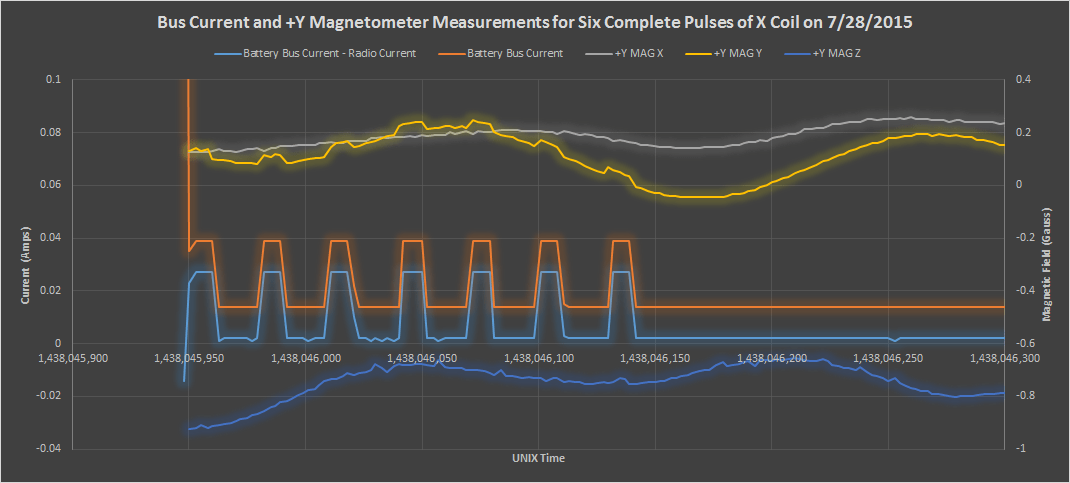
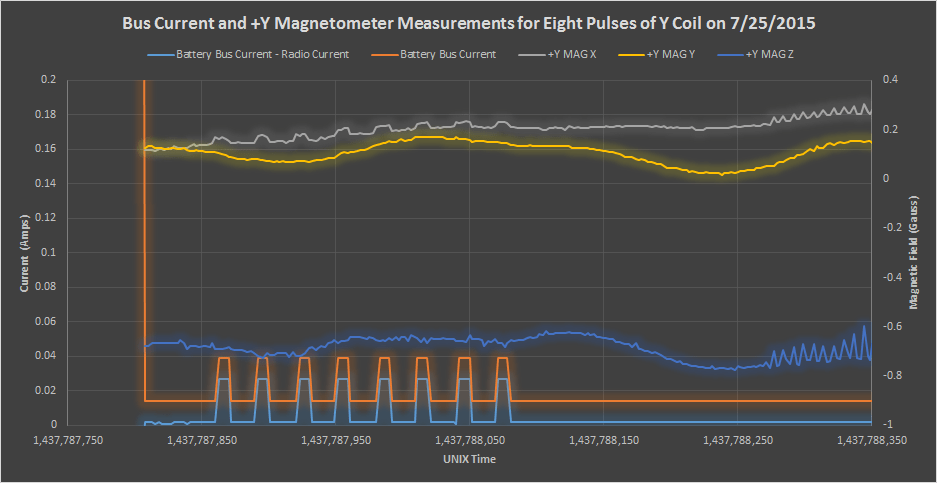
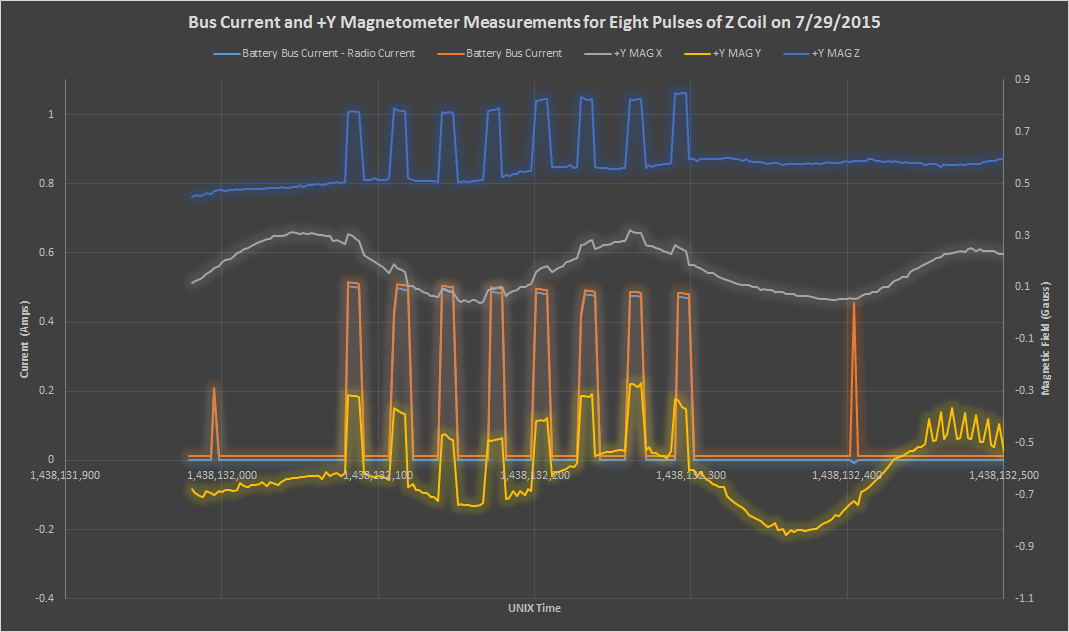
You’ll note that the X and Y coils draw much less current than the Z coil does and generate a much weaker change in magnetic field – this is because the Z coil needs to be strong enough to overcome the permanent magnet on GRIFEX (which is aligned with the Z axis of the spacecraft) if necessary. Thus far, we have only experimented with running current in one direction through the magnetorquer coils, but we plan on completing “pulse” tests with current running the opposite direction before we attempt full attitude control of the spacecraft.
Another event to note is that GRIFEX stopped beaconing sometime between 7/30/2015 23:45:00 UTC and 7/31/2015 00:51:00 UTC. At the 00:51:00 UTC pass over Ann Arbor, we attempted to reset the spacecraft, but to no avail; GRIFEX was neither beaconing nor responding to any commands we sent. GRIFEX remained silent throughout 7/31/2015, but luckily a watchdog timeout reset the spacecraft and we started picking up beacons again on 8/1/2015 13:55:00 UTC. We are still unsure of what caused this anomalous behavior, but we have been downlinking telemetry from the time period during which GRIFEX was silent (beacons were still being created and saved on the spacecraft) to debug the problem and ensure it does not happen again. A big shout out to the hams that were tracking GRIFEX during this worrisome time and alerting us to the fact that it was silent! We are all very glad that the GRIFEX mission can continue now that the spacecraft is beaconing again.
Thanks again for all your support.
Valerie Chen (KG7RGV)

 Virginia Tech has approached the US Government to fly the Phase 3-E space frame into High Earth Orbit (HEO) in order to support scientific payloads as well as serve as an amateur radio satellite. During the AMSAT-DL Annual Meeting on 4 JUL 15, the AMSAT-DL membership approved the concept, agreeing to allow the Phase 3-E space frame that is currently stored in Germany to be shipped to Virginia Tech in the USA for further construction, testing and preparation for eventual launch to HEO should the US Government formally agree to fund such a mission.