RAIKO, FITSAT-1, WE-WISH, TechEdSat, F-1
They will be loaded into the J-SSOD deployer on ISS KIBO with TechEdSat and F-1 by HTV-3 (Kounotori-3) on 21 July 2012.
These satellites will be deployed from KIBO by the robotic arm in September 2012.
RAIKO (Wakayama University)
100 x 100 x 200 mm 2U
http://www.astro.mech.tohoku.ac.jp/RAIKO/
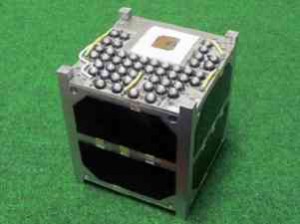 FITSAT-1 (Fukuoka Institute of Technology)
437.250MHz CW, 437.445MHz FM, 5840.00MHz High speed data
http://www.fit.ac.jp/~tanaka/fitsat.shtml
WE WISH (Meisei Electric Co., Ltd.)
437.505MHz SSTV, Telemetry, CW
https://sites.google.com/site/jq1ziijq1zij/
TechEdSat will be deployed from the International Space Station (ISS). It is a 1U CubeSat that will demonstrate Plug and Play power architecture and two way communication via the satellite phone/data networks Iridium and Orbcomm.
There will be a 437.465 MHz beacon transmitting 1 watt to 1/4 wave monopole. Commanding is via the commercial networks and there is a 2 week watchdog timer to stop the beacon in the event of no commands being received.
TechEdSat will be launched along with Raiko, FITSat-1, We-Wish and F-1 to the ISS aboard HTV-3, currently planned to launch July 21, 2012. From there, it will be deployed into Low Earth Orbit using the JAXA J-SSOD deployer, from the Japanese Experiment Module (JEM also known as Kibo). They will be deployed with the Kibo robotic arm planned for September, 2012.
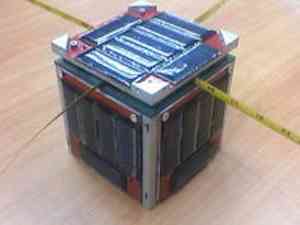 Wiki-TechEdSat http://en.wikipedia.org/wiki/TechEdSat
F-1, Vietnam Student CubeSat
Downlink: 145.980MHz, 437.485MHz
Mode:     AFSK 1200bps, GMSK 9600bps, AX.25 KISS
Size:     10x10x10cm (1U cubesat)
Mass:     1kg
Payload:  C328 camera with 640x480 resolution
Main website: FSpace Laboratory
[PE0SAT Thanks JE9PEL, Mineo Wakita via amsat-bb for this information]
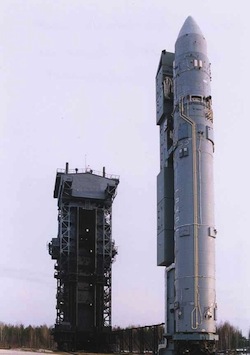
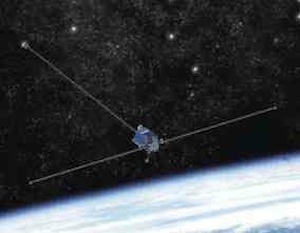 The small spacecraft MiR (Yubileiny-2) is one of them. The satellite was named after Mikhail Reshetnev, the founder and the first director of the company. The previous satellite for scientific purposes – Yubileiny – was placed into orbit in 2008 and since then it has exceeded the designed lifespan by three times and now is still carrying out its mission. ISS-Reshetnev has recently completed MiR, and the satellite is to be inserted into LEO with the next launch of a Rockot vehicle.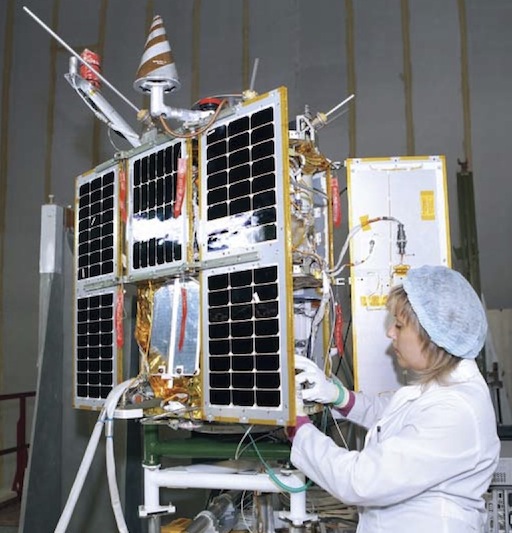
 Uplink
 The 7849km AO-7 world record set by AC0RA and I (NZ5N) on July 2 lasted less than 48 hours. Wyatt once again woke up early and this time drove 150 miles to EN41ad. We had a 30 second QSO at 0949Z to extend the record to 7903.55km. Thanks, Wyatt, this has been fun.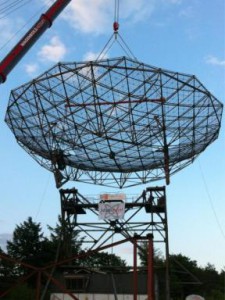
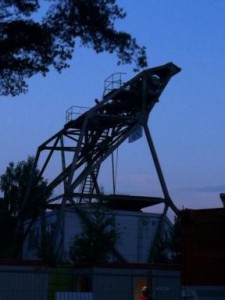
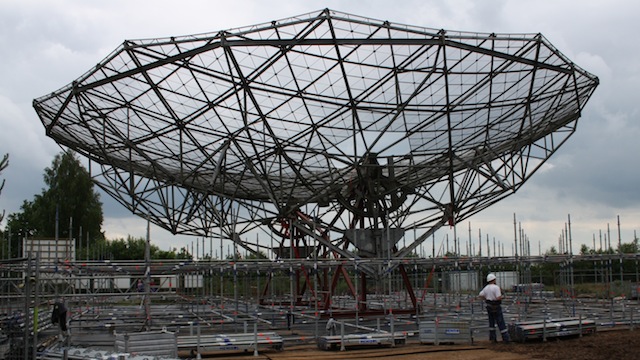
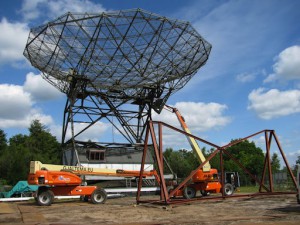 The dismantling of the dish in Dwingeloo has started. Today, the dish would be lifted only by an error in the calculation of the weight is was not successful. The starting points of weight are not correct and there is more than 40 tons of force needed to be able to lift the dish.