The commands to ‘Turn On’ the transponder # 2 (Dutch transponder, made by Williams PE1RAH) on-board HAMSAT VO-52 was successfully sent during 14:00 UT 35 deg ascending Node pass over Bangalore, India.
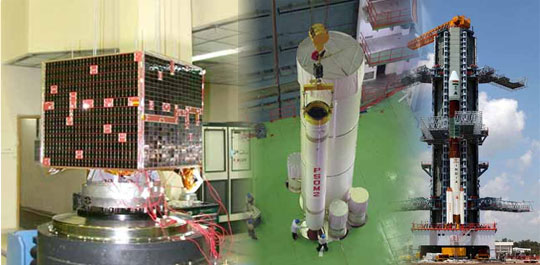
The sent commands were successfully received, acknowledged and confirmed by the telemetry. Subsequently, the transponder # 2 is now ‘ON’ and Williams CW message beacon was heard again after a gap of approximately 6 years & 4 months.
The beacon signal was heard loud and strong here at Bangalore.
A detailed Initial reports addressed to: tprangan@istrac.org and a copy to wmy@isac.gov.in would be greatly appreciated.
[PE0SAT Thanks VU2WMY and PE1RAH for the above information]
After this message on Amsat-BB my first possibility to listen for VO-52 was on 14-03-2012 15:55 UTC. During this pass I made the following recording of the CW beacon on 145.860. Listen to my recording via the following link [download id=”14″]. The elvation was 2 degrees and The signals where 5 – 5 up to 5 – 7. When listening to the recording there is some distortion that is likely caused by transponder use with too much power.
HI HI HI THIS IS VUSAT WITH THE DUTCH MODE UV TRANSPONDER MADE BY WILLIAM LEIJENAAR 73 DE PE1RAH
HI HI HI THIS IS VUSAT WITH THE DUTCH MODE UV TRANSPONDER MADE BY WILLIAM LEIJENAAR 73 DE PE1RAH
HI HI HI THIS IS VUSAT WITH THE DUTCH MODE UV TRANSPONDER MADE BY WILLIAM LEIJENAAR 73 DE PE1RAH
It is good to hear that the Dutch transponder is operationel again after so many years, a job wel done by William Leijneaar (PE1RAH), who has built this transponder.

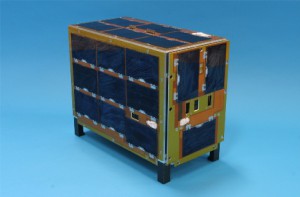
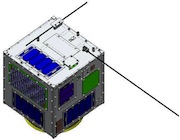 Built by students at the Kyushu Institute of Technology (KIT) HORYU-2 is 350 * 310 * 315 mm and mass is 7.1 kg. Launched into a Sun-Synchronous 680 km orbit with an inclination of 98.2°and operate on 437.325 MHz using either 20 wpm Morse Code or 1200 bps AX.25 GMSK.
 VO-52 seems to be down, it hasn’t been heard in the last couple of days. I hope that the ground station in India will give some information about the status of this great Satellite soon.
 Today we put up a multi band antenna that can be used for 28, 21 and 14 MHz. The next couple of days we will give Oscar 7 a try when it is in mode A. I hope noise levels are much lower in mode A then in mode B. It is very difficult to work stations because of the high noise level when the satellite is in Mode B and is descending to the north.
 Ground Station of CO-65 says that Digipeater is always open in March all over the world.